

Winning Pipeline When Buyers Ask AI Before They Ask Google
A direct, step-by-step guide for demand generation and content leaders ready to execute
Table of Contents
- Getting Started
- When to Use This Guide
- What You Need Before You Start
- Roles and Responsibilities
- The Steps to Follow, In Order
- Decision Points to Apply as You Go
- Handling Internal Pushback
- Templates and Checklists You Can Use Directly
- What to Measure
- A Realistic Timeline
- What Usually Goes Wrong
- Closing Note
Getting Started
This guide gets you from a traditional, Google-first content and SEO program to one built for how B2B buyers actually research in 2026, without throwing out the channels that already work. It is written to be executed, not debated. Follow it in order the first time through. After that, use it as a working reference: pull up the exact section you need when you need it.
The starting fact that makes this guide necessary: 51% of B2B software buyers now begin their vendor research inside an AI chatbot rather than Google, up from 29% less than a year earlier, according to G2’s 2026 Answer Economy report. Most companies have not adjusted for this yet.
One idea runs through everything that follows: getting cited inside AI answers is not a side project you run alongside your existing content program. It is the standard every step below is designed to meet. Read it that way, and the rest of this guide is simply a checklist.
Keep this guide open on a second screen while you work through your first audit and restructuring sprint. Each section builds on the one before it, and skipping ahead usually means redoing work later once a gap shows up in a real buyer’s AI chatbot session instead of on paper.
When to Use This Guide
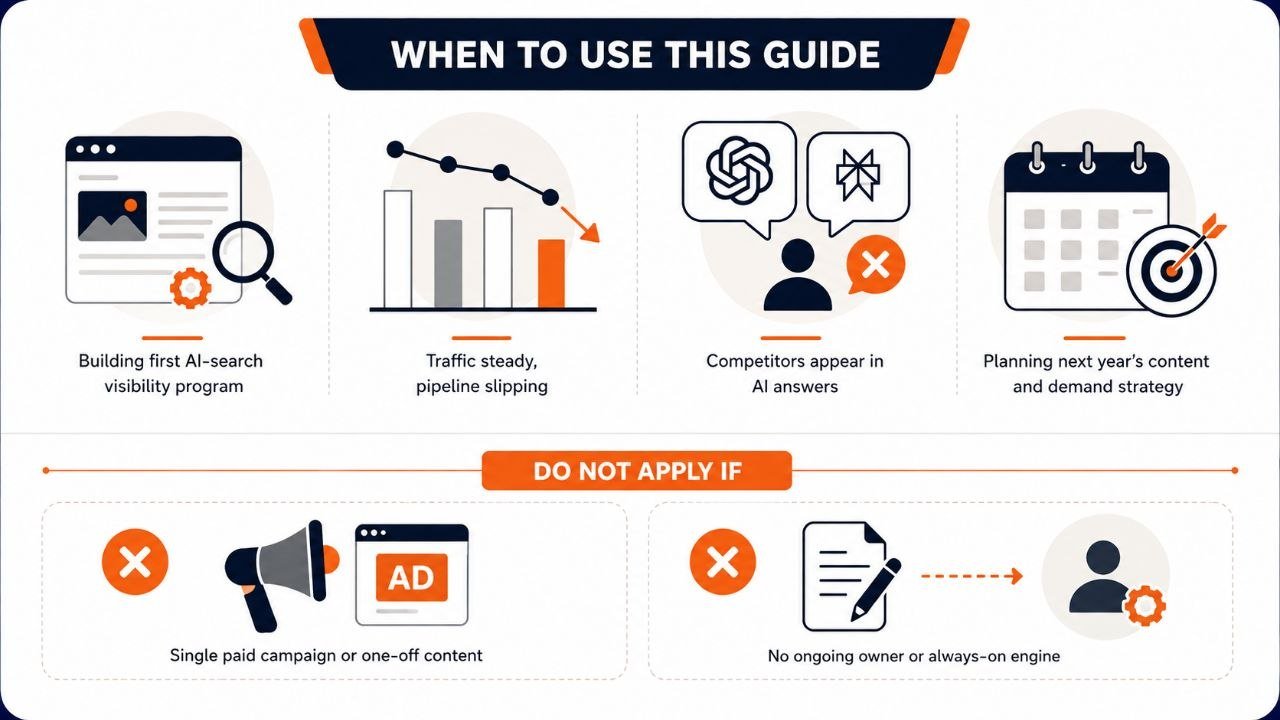
This guide applies when any of the following is true for you right now:
- You are building your first AI-search visibility program, alongside an existing SEO or content operation.
- Your organic traffic and rankings have held steady, but pipeline sourced from content has started slipping.
- A competitor shows up when you ask ChatGPT or Perplexity a buying question in your category, and you do not.
- You are setting next year’s content and demand generation strategy and need to account for AI-mediated research.
Do not apply this guide to a single paid-media campaign or a one-off content sprint with no ongoing owner. This is built for the always-on content engine, the same one already producing your blog, comparison pages, and gated assets, not a side project with its own budget line.
If you have no existing content or SEO program at all, build baseline content first. This guide restructures and prioritizes what you already have; it does not replace the work of having something to restructure.
What You Need Before You Start
Do not move past this section until all five of these are in place.
- Leadership alignment that AI-search visibility is now a tracked marketing metric, not a curiosity someone checks occasionally.
- A baseline audit: your current visibility across ChatGPT, Perplexity, and Google AI Overviews for the buying questions your ICP actually asks.
- A named owner for structured data and schema implementation, someone with real access to the CMS, not just a request queue.
- Baseline numbers from your current program: organic traffic, MQL-to-SQL conversion rate, and content-sourced pipeline.
- An inventory of your highest-value existing pages, ranked by traffic or pipeline contribution, not a blank content calendar.
Assign an owner for each item above, not just a department. A prerequisite with no named owner tends to sit half-finished until the first sprint is already underway, and by then it is harder to fix without pausing the whole restructuring effort. Put a name and a date next to each line before you consider this step complete.
Roles and Responsibilities
Assign these before you start, not after. A rollout with unclear ownership is one of the fastest ways an AI-search program stalls once it moves past the first few pages, because everyone assumes someone else is watching the details.
Role | What they own |
Demand gen or marketing leader | Final sign-off on scope, priority pages, and success criteria |
Content lead or writer | Restructuring existing pages for extraction, writing new comparison content |
SEO or growth marketer | Schema implementation, tracking both rankings and AI citation changes |
Web or CMS admin | Making sure AI crawlers are not blocked by default, publishing schema correctly |
Sales or RevOps | Flagging which buying questions and objections actually come up on real calls |
PR or comms | Managing third-party listings, review platforms, and community presence |
Put a name next to each row, not a department. If one person holds two roles, that is fine for a first sprint, but write it down anyway so nothing falls through once the program scales past a single person’s capacity.
The Steps to Follow, In Order
Work through these five steps in sequence. Do not skip ahead, even if a later step feels more urgent than the one in front of you.
Step 1: Audit Your Current AI Visibility
- List the buying questions your ICP actually asks, pulled from real sales calls and support tickets, not assumptions.
- Run each question through ChatGPT, Perplexity, and Google AI Overviews.
- Note whether you are mentioned, how you are characterized, and which competitors appear instead.
Do not move to the next step until you have a scored list of which questions you own and which you are absent from. 2X’s 2026 AI Visibility Index found that 96% of B2B companies are invisible during early-stage AI buyer discovery, only 4.3% maintain what it calls a healthy discovery funnel. Most brands only surface once a buyer already knows their name, which is the least useful place to appear.
Agencies that specialize in this, Qoulomb among them, typically start every new client engagement with exactly this exercise: running the client’s real buying questions through each AI surface before touching a single page, so the restructuring work in Step 2 targets the actual gaps instead of guesses.
Most brands don't know how visible they are in AI search
Get a clear view of your AI search presence and competitor gaps.
Step 2: Restructure Your Highest-Value Pages for Extraction
- Rewrite the opening of each page to answer the core question directly in the first few sentences. Do not bury the answer under a long preamble.
- Add a self-contained key-takeaway statement to every major section, one that makes sense pulled out of context.
- Add FAQ schema in JSON-LD format to any page structured as questions and answers.
- Replace hedged, vague phrasing with direct, definitive statements wherever the underlying fact supports it.
Definitive phrasing matters more than most teams expect: one 2026 analysis of AI citation patterns found that cited passages are nearly twice as likely to use definitive language as hedged language, and that 65% of AI bot crawl activity targets content published within the past year. A well-written page that is a year stale competes with a weaker page that was refreshed last month, and often loses.
Step 3: Build Comparison and Category Content
AI models get asked direct comparison questions: which tool is best for a given use case, how one vendor differs from another. Your content needs to answer that honestly and directly, not dodge it with vague positioning copy.
- Write the comparison your buyer is actually asking for, including where your product is not the right fit.
- Do not write a one-sided page. Balanced, specific answers get extracted more easily than pure pitches.
This is the exact content layer that GEO-focused agencies build their engagements around: Qoulomb‘s own positioning, for instance, is built specifically on getting a client’s brand cited inside ChatGPT, Gemini, Perplexity, and Copilot for comparison and category questions, tracked across a dozen or more AI surfaces rather than a single ranking report.
Step 4: Extend Beyond Your Own Domain
A meaningful share of AI citations trace back to sources you do not control directly: business and software listings, review platforms, and forums. Treat this as demand generation work, not an administrative afterthought.
- Audit your presence and accuracy on the listing and review sites your category cares about.
- Check whether AI crawlers are blocked by default in your robots configuration, and make that a deliberate decision, not a default.
- Assign an explicit owner to third-party presence. It is usually nobody’s job today, which is exactly why it gets missed.
Step 5: Run a Bounded Content Sprint and Re-measure
- Pick 2 to 5 priority pages or questions from your Step 1 audit list.
- Restructure and publish, then wait for re-crawl. Perplexity can re-index within days; other engines take longer.
- Re-run the exact prompts from Step 1 and compare results directly.
- Only then scale the same pattern across the rest of your content library.
Decision Points to Apply as You Go
Use the table below as a lookup whenever one of these situations comes up, rather than reading it start to finish.
If this happens | Then do this |
A competitor appears in an AI answer where you do not | Prioritize that exact question next. Do not attempt to rebuild the whole site at once |
An AI tool gives an outdated or wrong description of you | Publish a clear, current, citable page correcting it. Do not just flag it internally and move on |
Organic traffic is flat but AI-referral traffic is rising | Do not panic or abandon SEO. The two channels behave differently and are not a zero-sum swap |
A page ranks well on Google but is never cited by AI | Check its structure, not its ranking. Citation overlap between AI engines is low, so this is common, not a failure |
A core buying-question page is more than 90 days stale | Refresh it before writing anything new on the same topic |
Legal or security wants to block AI crawlers by default | Make it a deliberate, documented tradeoff, not a reflexive setting |
Handling Internal Pushback
You will get questions before you get results. Use direct answers, not long justifications, and point back to the plan.
If you hear this internally | Say this |
We already rank on Google, why does this matter | 51% of B2B buyers now start research in an AI chatbot instead, up from 29% a year earlier. Ranking on Google does not guarantee you are in that conversation at all |
This is just more SEO busywork | It is a different extraction target for the same content investment, not extra keyword stuffing. Most existing pages need restructuring, not replacing |
We do not have budget for a new team | This is a reprioritization of existing content work. Marketing budgets are flat industry-wide, so the case here is about where the same spend goes, not new spend |
If AI already picked the winners, we have lost this race | Only 4.3% of B2B companies have a strong AI discovery presence today. The field is still wide open, most competitors have not done this work either |
Buyers still talk to sales before they decide | True, but most B2B buyers are not in active-buying mode at any given moment, and they are forming vendor opinions long before that conversation, often through AI-mediated research |
Templates and Checklists You Can Use Directly
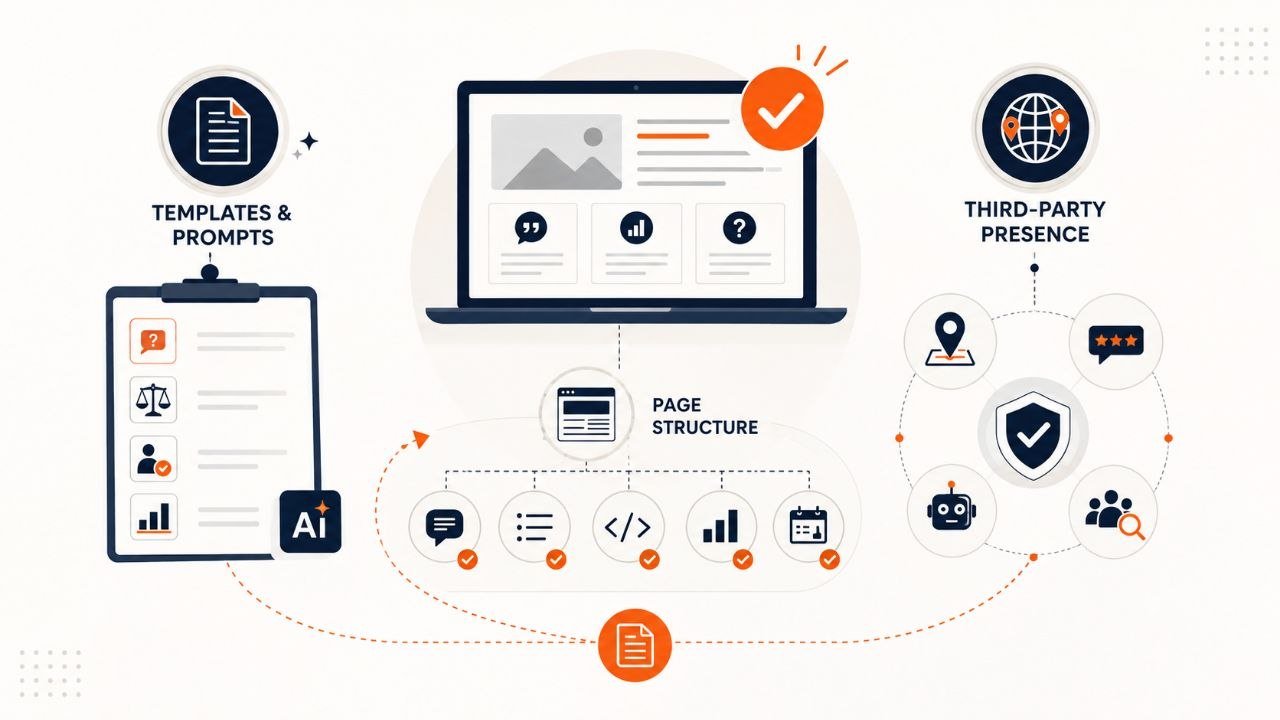
AI Visibility Audit Prompt List
- What is [category] and which tools are considered the best options?
- Compare [your product] versus [main competitor] for [specific use case].
- What should a [buyer persona] look for when choosing a [category] tool?
- Is [your company name] a good fit for [specific need]?
Page Restructure Checklist
- Direct answer in the first two to three sentences, before any preamble
- Self-contained key-takeaway statement in every major section
- FAQ schema in JSON-LD format, matching the visible on-page content exactly
- At least one named, sourced statistic that is not available elsewhere on the page
- Definitive phrasing in place of hedged language, wherever the underlying fact supports it
- A visible, current publish or refresh date
Third-Party Presence Checklist
- Listings and directories relevant to your category are claimed and accurate
- Review platform profiles are current and monitored
- AI crawlers are not blocked by default without a documented reason
- Someone is assigned to check category conversations on forums and community platforms monthly
What to Measure
Check these weekly during your first sprint. Move to monthly review once you have scaled past the initial batch of pages.
Metric | Check how often | Where to pull it |
AI citation presence and characterization | Biweekly | Manual prompt audit across engines |
Share of traffic referred from AI platforms | Weekly | Web analytics |
Organic search traffic and rankings | Weekly | SEO tool |
Content-sourced MQL-to-SQL rate | Monthly | CRM |
Comparison and category page engagement | Monthly | Web analytics |
Citation change after a content refresh | Per sprint | Manual re-check of Step 1 prompts |
A Realistic Timeline
Timeframe | What to focus on |
Days 1 to 30 | Complete the prerequisites, assign roles, run the audit, and build your prioritized question list |
Days 31 to 45 | Restructure the first batch of pages and build out comparison or category content |
Days 46 to 60 | Extend to third-party presence and listings, then review results against your baseline |
Days 61 to 90 | Scale the pattern across the rest of your content library and set a recurring refresh cadence |
What Usually Goes Wrong
- Teams treat this as a one-time project instead of a recurring discipline. Fix: put the refresh cadence on a recurring calendar, not a one-off sprint.
- All the effort goes into new content, none into fixing top existing pages. Fix: prioritize the Step 1 audit list before writing anything new.
- Teams optimize only for ChatGPT and assume the other engines follow. Fix: audit and structure for each engine separately, citation overlap between them is low.
- A cautious, hedged brand voice quietly undermines extraction. Fix: rewrite key passages in direct, definitive language without losing accuracy.
- Third-party presence gets ignored because no one owns it. Fix: assign an explicit owner, the same way content has one.
- AI crawlers get blocked by default without weighing the tradeoff. Fix: make it a deliberate, documented decision, not a default setting.
Closing Note
Run this guide well, and AI-search visibility stops being a risk you worry about occasionally and becomes a channel you can measure and improve on a schedule. Agencies built around exactly this problem, Qoulomb among them, run new client content through the same restructuring checklist above before it publishes, treating AI-citation readiness as a standard step alongside traditional SEO, not an extra pass at the end.
None of the steps above require a new team or a bigger budget than what you are already spending on content today. What they require is discipline: audit honestly, refresh on a real cadence, and do not scale a pattern across your whole library until a small batch has actually proven it works.
Keep the decision points and metrics sections open as you go. You will return to them every time you restructure a new batch of pages, not just the first time you read this guide.